
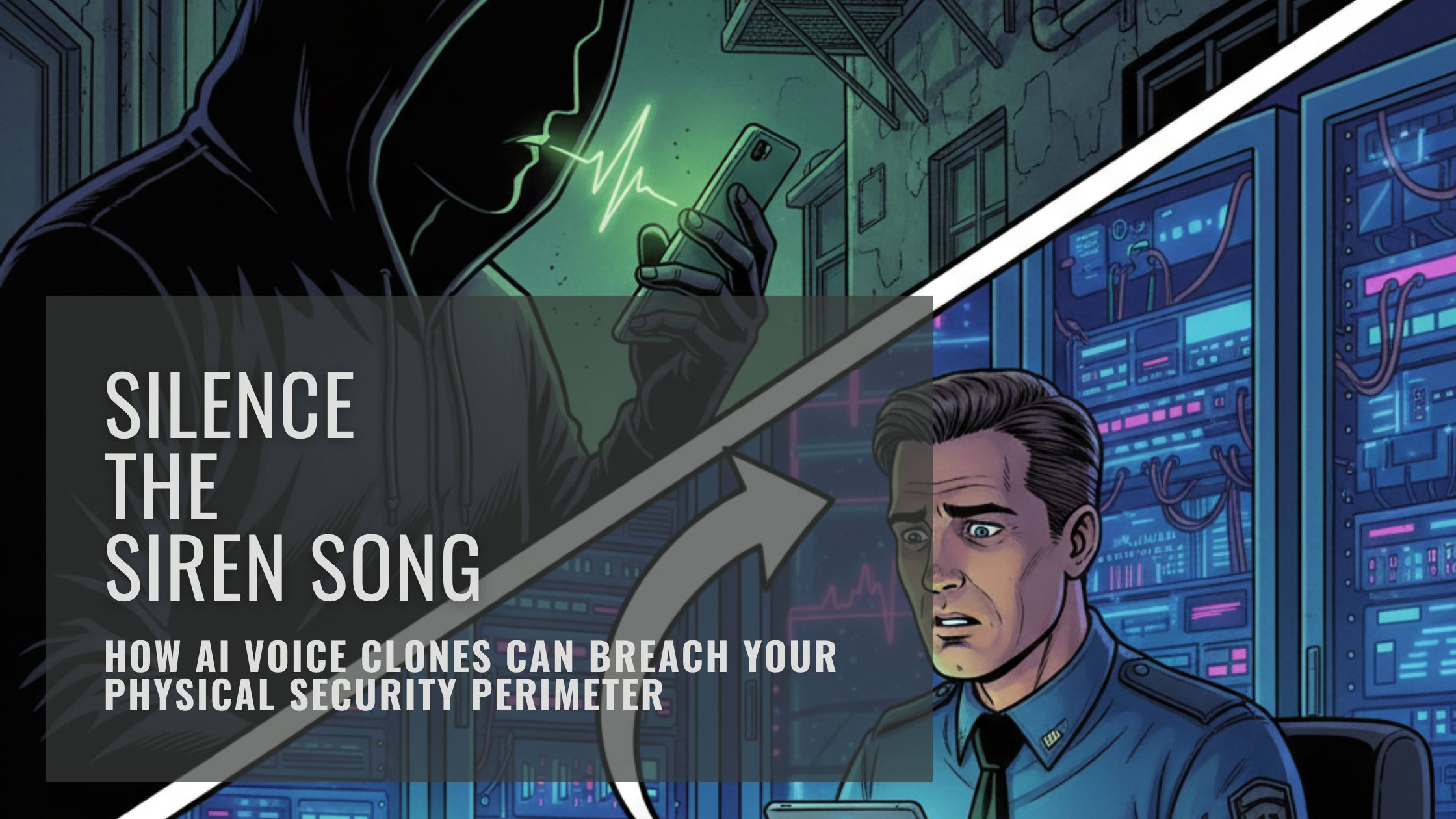
The rapid evolution of Artificial Intelligence (AI) has introduced an unprecedented threat to organizational security: real-time voice cloning. This technology, which creates synthetic audio content (deepfake) that is often indistinguishable from a human voice, transforms the decades-old tactic of vishing (voice phishing) into a highly potent weapon for social engineering. For physical security professionals, this is not a distant, theoretical threat; it is a current and scalable risk vector designed explicitly to exploit trust and bypass established access controls.
I. The Invisible Insider: AI Voice Cloning and the Erosion of Trust
1. The New Threat Landscape: Weaponizing Identity
Deepfake vishing leverages AI voice cloning to replicate a target’s pitch, tone, intonation, and speech rhythms. The attack strategy is straightforward but devastatingly effective: impersonate an authoritative figure—such as a CEO, a facility manager, or a trusted insider—to issue rogue directives, release sensitive information, or compel an employee to perform actions on behalf of the attacker.
The ultimate goal for an attacker is to achieve a physical security bypass. This might involve tricking a security guard or an administrative staff member into executing a remote unlock command for a secure door, providing master key codes or facility access combinations, or temporarily disabling video surveillance or access control systems under a manufactured pretext of urgency or crisis.
The upward trend in fraud confirms the methodology’s success and scalability. Statistics show that the financial sector remains a prime target, with 53% of financial professionals reporting deepfake scam attempts as of 2024. The financial impact is escalating rapidly; deepfake fraud attempts increased by a massive 3,000% in 2023 alone. Furthermore, businesses lost an average of nearly $500,000 per deepfake-related incident in 2024. This substantial and growing financial impact underscores why physical security operations must urgently adapt their verification protocols to combat this evolving threat.
2. The Anatomy of the Real-Time Imposter
Modern deepfake technology overcomes the key technical limitations that plagued earlier voice synthesis attempts. Historically, vishing attacks were constrained by the reliance on older Text-to-Speech (TTS) models. These models either forced attackers to use awkward, pre-recorded sentences or introduced unnatural delays when inputting sentences on-the-fly, which would inevitably arouse suspicion in the victim.
The current breakthrough lies in the development of sophisticated real-time Voice Conversion (VC) frameworks, often referred to as “zero-shot” cloning systems (like SV2TTS). These technologies can clone an unseen voice using just minutes—or even a few seconds—of reference speech without requiring a lengthy retraining process. These systems typically employ a multi-stage pipeline, including a speaker encoder to extract the unique vocal characteristics (the identity content), a feature prediction network (decoder) to align the text with the speaker’s style, and a high-fidelity Generative Adversarial Network (GAN)-based vocoder to synthesize the final, realistic audio waveform. The state of the art in open-source AI further lowers the barrier to entry. Advanced, free, and open-source models like ChatterBox have been demonstrated to outperform major commercial platforms in blind evaluations, offering features like ultra-low latency, multilingual support, and unique emotion control. These models, often released under permissive licenses, are production-grade tools built on cutting-edge research, such as the SV2TTS framework. They are specifically designed for zero-shot voice cloning, requiring only a few seconds of reference audio to generate arbitrary speech in real time.
Crucially, the tools and infrastructure needed for real-time voice cloning are now widely accessible and affordable. An attacker can train a sophisticated model in just a few hours using minutes of publicly available audio samples harvested from sources like corporate blogs, social media, or YouTube. This capability is no longer restricted to well-resourced institutions; proof-of-concept projects have demonstrated that a single individual, utilizing open-source AI models and commercial cloud services (such as AWS managed telephony), can build a “rudimentary yet highly scalable voice cloning telephony platform in a matter of a few hours”. The financial outlay required to achieve these results is certainly within the reach of many individuals and small organizations, using affordable, barebones hardware.
The ease and low cost of mounting a deepfake attack introduces a significant strategic disparity, contrasting sharply with the massive financial and operational costs organizations incur when defending against or recovering from a successful breach. This asymmetry of effort highlights that defense strategies focused purely on technical detection will inevitably lag behind the rapid evolution of the attack tools. This mandates that physical security strategies must shift toward emphasizing immediate procedural resilience.
Furthermore, the initial point of vulnerability for the physical security perimeter is often the organization’s digital hygiene. The attack workflow begins with Open Source Intelligence (OSINT) gathering, where audio samples and psychological profiles of key personnel are collected from public internet sources. The cloned voice is only effective when combined with targeted social engineering that exploits the emotional triggers and assumed trust between the victim and the impersonated authority figure. Therefore, a critical prerequisite for protecting physical assets is the proactive auditing and restriction of public access to audio and video content featuring key executive staff or facility managers.
II. The Telephony Blitz: Assessing Attack Likelihood Across Communication Channels
Voice cloning efficacy across communication channels—cell phones, radios, and walkie-talkies—demands an analysis of technical feasibility versus the probability of human deception. The analysis confirms that no conventional communication channel used in security operations is inherently safe from this threat.
3. The High-Fidelity Threat: Cell Phones and VOIP
Standard telephony systems, including cell phones and Voice over IP (VOIP), represent the highest likelihood vector for a high-quality, real-time deepfake attack. These channels offer full-duplex communication and high audio bandwidth, which allows the synthesized voice to sound highly natural and facilitates the fluid, real-time conversation required for effective social engineering.
Attackers typically compound this risk by combining real-time cloning with phone number spoofing, ensuring that the victim sees a trusted and familiar caller ID on their device. This creates immediate operational danger, not just for staff manipulation but also for logical access systems. Voice authentication, often used as a “vocal password” to access sensitive accounts or unlock high-security intercoms, has been proven susceptible to bypass by modern cloning technology, as the AI is explicitly trained to replicate the biometric vocal characteristics analyzed by these systems (pitch, tone, and speech patterns).
4. The Radio Riddle: Analyzing Digital and Analog Channels
Physical security and facility management rely extensively on Land Mobile Radio (LMR) systems, including digital standards like Project 25 (P25) and Digital Mobile Radio (DMR), and simpler analog walkie-talkies. These systems present unique and counterintuitive constraints for deepfake deployment.
Digital Radio Systems (P25/DMR)
Digital radios utilize aggressive, lossy compression algorithms, known as vocoders (such as the AMBE2+ vocoder in P25 Phase II), to transmit voice signals across narrow frequency bandwidths. While this compression degrades the raw signal quality—which might seem to complicate the attacker’s task—it actually introduces a critical vulnerability.
This lossy compression can inadvertently obscure the subtle synthetic artifacts that deepfake detection algorithms, or even the most vigilant human ear, might detect in a high-fidelity cell call. The listener is already accustomed to the unnatural, digitalized sound of the radio, effectively lowering their suspicion threshold. This means that the technical characteristic intended to optimize bandwidth—the vocoder veil—may actually work in favor of the attacker.
Analog Walkie-Talkies and Intercoms
Analog walkie-talkies and intercoms operate with high background noise, static, and severely limited audio bandwidth (low-fidelity). While cloning a voice perfectly and maintaining high fidelity over this channel is technically difficult, the poor signal quality reduces the expectation of clarity for the staff member on the receiving end. The human brain is prone to ‘filling in the gaps’ when presented with a familiar (but distorted) voice of authority over a static-filled channel. This manipulation of “authority bias” means deception is highly probable, even if the clone is technically imperfect.
Given that attackers can easily find target phone numbers and deploy highly scalable telephony infrastructure using cloud services , the likelihood of a deepfake attack being attempted across all these channels is High. The probability of successful deception against security personnel remains high-to-medium across the board, demonstrating that no communication method is inherently safe,
Table Title: Deepfake Attack Likelihood Across Security Communications
| Communication Channel | Technical Feasibility (Quality) | Deception Likelihood Against Personnel | Key Risk Factor for Physical Security |
| Cell/VOIP Phones | High (Real-Time, Full Bandwidth) | High (Exploits trusted Caller ID) | Direct order issuance; bypassing voice biometric intercoms. |
| Digital Radios (P25/DMR) | Medium (Vocoder Compression/Lossy) | Medium-High (Compression may mask synthetic artifacts) | Impersonating Shift Supervisors to direct operational changes or gain status updates. |
| Analog Walkie-Talkies/Intercoms | Low-Medium (High Noise/Low Bandwidth) | Medium (High noise reduces suspicion of synthetic flaws) | Social engineering guards by exploiting the “authority bias” over a familiar, immediate channel. |
The ability of noise or lossy compression to mask synthetic flaws means that technical reliance on staff to discern subtle acoustic differences is fundamentally flawed. Any robust countermeasure must therefore be procedural, applied universally irrespective of communication channel quality.
Beyond targeted impersonation, AI voice cloning is capable of supporting life-like voice Distributed Denial of Service (DDoS) attacks. By combining large scale language models (LLMs) with automated voice cloning, threat actors can generate hundreds or thousands of conversation variations, containing specific details like dates, times, or topics. This weaponized content can be used to flood a security office or central control room with thousands of simultaneous, highly believable vishing calls. This creates operational paralysis and confusion, achieving the attacker’s goal of disruption or distraction while a coordinated physical breach occurs elsewhere.
III. The Fortress Protocol: Layered Defenses Against AI Imposters
Countering the pervasive threat of real-time voice cloning requires abandoning the notion of single-point defense. Security experts agree that the only viable solution is a multilayered strategy that integrates human policy, technical systems, and physical access controls. This necessitates a comprehensive, three-layered defense protocol.
5. Layer 1: Procedural Defenses (The Human Firewall)
The human element remains the most exploited, yet most easily hardened, layer. The efficacy of procedural controls lies in requiring verification through a channel that cannot be compromised by the initial voice deepfake.
The single most critical procedural defense is establishing a Mandatory Out-of-Band Verification (OOBV) policy. This policy must dictate that any sensitive or unusual request received via voice—especially orders for access changes, key retrieval, or large financial transfers—must be verified using a different, previously agreed-upon, secure communication channel. For instance, if a voice call from a trusted figure delivers an urgent order, the recipient must hang up and call the individual back on a pre-verified, known landline, or send a confirmation request via a secure internal messaging platform. This step immediately breaks the attacker’s real-time communication loop.
Organizations must also implement Challenge Codes and questions. These are unlisted, agreed-upon “safe words” or unique questions known only to the two individuals communicating, serving as a non-digital, non-replicable password that cannot be discovered through external OSINT research.
Finally, standard annual awareness programs are insufficient against this threat. High-Impact Employee Education must include realistic, unannounced deepfake vishing simulations targeting security and administrative staff. This trains employees to recognize red flags and react effectively under pressure, directly addressing the fact that an untrained employee is often the largest vulnerability. Organizations should also restrict the public disclosure of audio, video, and internal protocol details concerning key personnel.
6. Layer 2: Logical Defenses (System Hardening)
Logical defenses focus on technical detection and system resilience, specifically against synthetic audio streams.
The most effective technical defense involves Deploying AI Anti-Spoofing Systems. These solutions, often integrated into contact center infrastructure, utilize AI-powered audio analysis to distinguish synthetic speech from human speech. By analyzing unique acoustic characteristics (such as intonation, prosody, and the subtle artifacts inherent in synthesized audio), these systems generate real-time “liveness scores” to determine if the caller is human, thus providing an essential security layer for any institution reliant on voice-based communication.
However, given the proven ease of bypass , Voice Biometrics Must Be Reclassified. Voice authentication systems should never be the sole method for granting privileged access or confirming sensitive orders. Instead, voice recognition must be treated as a low-confidence factor, always requiring secondary verification.
For organizations at risk of Voice DDoS, technical Monitoring and Alerting capabilities are necessary. Call pattern monitoring can alert staff to high-volume, simultaneous call activity or suspicious routing anomalies targeting privileged numbers, allowing teams to identify and neutralize a flood attack before it causes operational paralysis.
7. Layer 3: Physical Defenses (Access Control Integrity)
The ultimate safety net for any organization is ensuring that a successful digital social engineering attack does not immediately lead to a catastrophic physical breach. This requires implementing physical access controls based on a “zero-trust” model.
For critical access points—such as server rooms, data centers, or vaults—organizations must enforce Two-Factor Physical Access. If an attacker successfully gains a sensitive access code via vishing, they must still be blocked by a secondary factor that cannot be transmitted over the phone. This typically involves requiring a key card or logical credential plus a non-replicable biometric scan (fingerprint or retina) or visual confirmation by an in-person, trusted guard.
Furthermore, Key Management Integrity protocols must be hardened. Any request for temporary access keys or changes to access schedules must require mandatory cross-referencing with the OOBV confirmation process before any physical item or code is released. Physical security personnel (those who answer intercoms and radios) act as the final “identity perimeter”. Protocols for security staff must explicitly remove individual discretion in sensitive scenarios, compelling them to defer all authority back to the institutional OOBV process.
This comprehensive, layered approach—encompassing policy, training, technology, and hardware—is the necessary response to the sophisticated deepfake threat. The focus on multi-factor physical access is a pivotal strategy, ensuring that the physical system is configured to fail-safe against the failure of the human or logical verification layers.
Table Title: Critical Countermeasure Checklist: Disarming the Deepfake Threat
| Defense Category | Method | Actionable Implementation | Vulnerability Mitigated |
| Procedural (Human) | Mandatory OOBV Policy | Institute a “Verify and Call Back” rule for any urgent/sensitive voice request, using a pre-verified channel. | Trust Exploitation / Impersonation |
| Physical (Access Control) | Two-Factor Physical Access | Upgrade critical points to require a key card (logical) + a physical biometric factor (fingerprint/retina). | Stolen Access Codes/Orders |
| Logical (Technology) | Liveness Detection Integration | Deploy AI anti-spoofing tools that analyze the call stream for synthetic audio artifacts in real-time. | Real-Time Voice Cloning |
| Procedural (Training) | Vishing Simulation Training | Conduct unannounced, realistic deepfake social engineering calls against security personnel quarterly. | Employee Training Gap / Human Error |
Conclusions and Recommendations
The analysis of AI voice cloning confirms that this technology represents a mature, scalable, and affordable attack vector with the direct capability to compromise physical security perimeters. The low barrier to entry for attackers, coupled with the ability of communication noise (such as radio compression) to mask synthetic audio flaws, makes relying solely on staff vigilance an unsustainable defense strategy.
For organizations seeking to fortify their defenses, the solution lies in adopting a policy-technology-training framework. Technical detection (logical defense) is necessary but ineffective without strict policy and continuous, realistic procedural training (procedural defense).
For physical security professionals and their organizations, the critical actionable recommendations derived from this analysis are:
- Mandate Procedural Resilience: Implement and enforce a zero-tolerance policy regarding sensitive requests over remote voice channels. All orders related to key access, alarm codes, or security system status changes must trigger mandatory, independent Out-of-Band Verification (OOBV).
- Upgrade Physical Access to Multi-Factor: Recommend and install access control solutions for high-value areas that explicitly require two independent, non-replicable factors (e.g., card key plus biometric verification) to ensure that a successful voice compromise cannot automatically translate into physical access. This implements a physical security zero-trust model.
- Integrate Training with Installation: Position the provision of enhanced physical security solutions alongside mandatory consulting services focused on security policy development and realistic deepfake vishing simulations for administrative and security staff. This holistic approach recognizes that the physical hardware is only as strong as the human protocols designed to protect it.